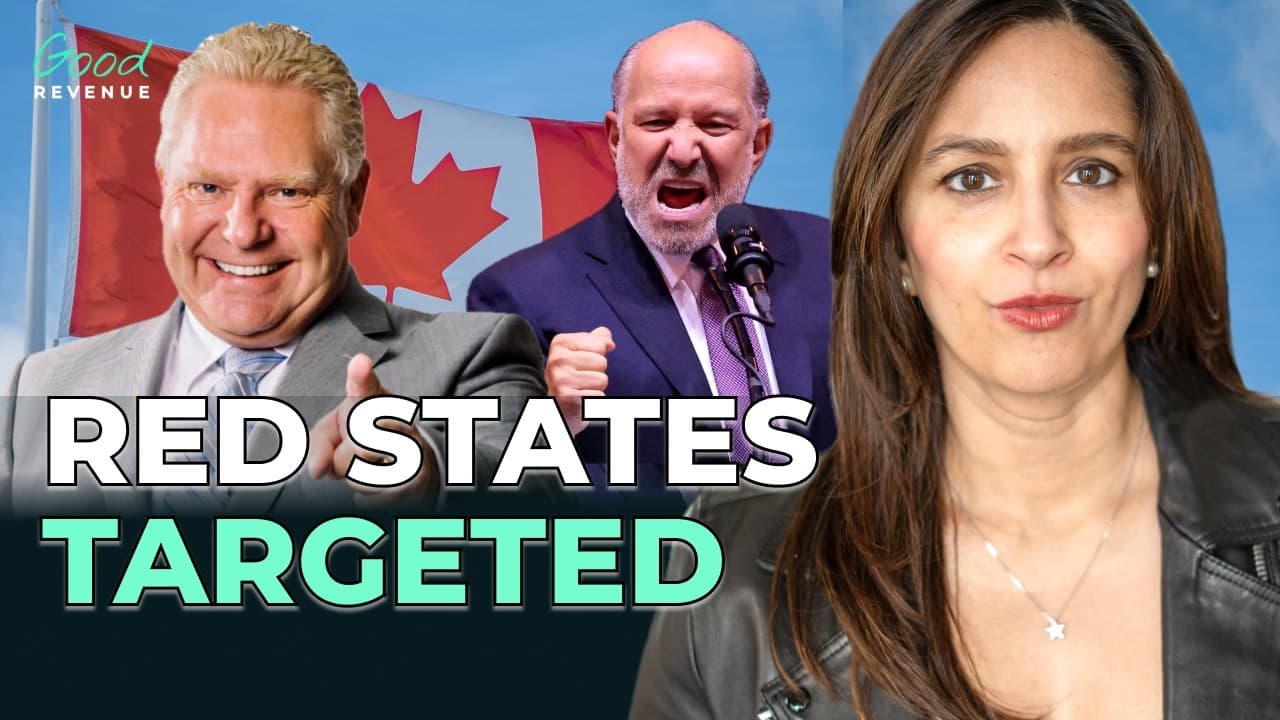
Canada Aimed Its Tariffs At US Swing States, Not Industries
A tit-for-tat tariff fight between two of the world's closest allies turns out to be less about economics and more about electoral math.
Tariff wars are usually sold as industrial policy. This one looks a lot more like a campaign strategy.
Canada just rolled out $20 billion in retaliatory tariffs matching, dollar for dollar, the tariffs the US president placed on Canadian goods using Section 338, a trade authority so rarely invoked it had never been used before. The headline categories are familiar: steel, aluminum, dairy, autos, electronics. But look closer at the target list, drawn from Globe and Mail visualizations referenced in this episode of Good Revenue, and a different story emerges. Canada's Minister of Industry admitted the list was built to hit specific US states that matter most politically to the sitting president, reportedly at the suggestion of Ontario Premier Doug Ford.
The Map Tells The Real Story
Eight states appear deliberately targeted: Wisconsin, Iowa, Texas, Alabama, Missouri, Arkansas, Montana, and Florida. These are not random picks. They are states where specific products, dairy, golf clubs, video game consoles among them, carry outsized local economic weight. Swing states like Ohio, Michigan, Illinois, and Pennsylvania are also caught in the crossfire, alongside blue strongholds like California and New York.
Perhaps the most telling detail is what Canada chose not to do. Early plans reportedly included heavy tariffs on Maine and Alaska seafood, states represented by Republican senators. At the last minute, those tariffs were scaled back. That is not the behavior of a country simply protecting its steel industry. That is the behavior of a government reading a political map as carefully as a trade ledger.
Everyone Loses, Just On Different Timelines
Neeta's core argument in this episode is simple and important: tariffs are taxes, full stop. Whether it is a Canadian buying US goods or an American buying Canadian dairy, someone downstream pays more. There is no clever workaround where a government slaps a tariff on a rival and only the rival feels it. Consumers and businesses on both sides absorb the cost.
The asymmetry is that Canada is the smaller economy, which theoretically makes it more vulnerable to sustained pressure. But the episode notes Canada appears to have real political appetite to endure short-term pain, especially with Prime Minister Mark Carney publicly stating that nothing is off the table, even as he has so far avoided the most drastic option floated by Doug Ford: cutting off energy exports to the US.
The trade numbers underscore how tangled these two economies already are. Canada sent 72% of its goods exports to the US in 2025 and imported 46% of its goods from the US, according to Statistics Canada figures cited in the episode. Meanwhile, the US actually runs a surplus in services trade with Canada, a detail that rarely makes it into the tariff headlines but matters for who is really winning and losing here.
Timing Is Not An Accident
None of this is happening in a vacuum. US elections are less than two months away, landing on November 3rd, and the episode's framing suggests that political timing is doing as much work as economic logic. The speculation floated is that cooler heads might prevail after the election, once the incentive to weaponize trade policy for domestic political points fades.
Until then, expect more escalation, not less. The US president has already moved on to targeting Bombardier with a boycott and floating 50% tariffs on autos, on top of a widely mocked attempt to rename Lake Ontario. None of it is helping. And the broader context, that this dispute sits inside a larger US-Canada-Mexico trade relationship worth trillions, means the stakes go well beyond golf clubs and milk.
The uncomfortable truth here is that a trade war between two of the closest allied economies in the world is being fought less over economic imbalances and more over electoral maps. That should worry anyone hoping for a quick resolution.
Sources & Further Reading
Canada's Retaliatory Tariff List Explained
Carney Vs Trump Trade War Escalation
Which States And Provinces Are Getting Hurt
US Canada Trade Data And Economic Backdrop