China's AI Dumping Strategy Could Bail Out Sam Altman
Kimi K3 is free, powerful, and built on a razor-and-blades playbook that is fracturing the US AI industry. The fight over banning it may decide who controls AI economics for a decade.
The Free Model That Costs Everything
When Moonshot AI released the weights for Kimi K3 on July 27th, it did not just drop a large language model into the wild. It detonated a fight that has been building for months over who gets to control the economics of artificial intelligence. The model is enormous, 2.8 trillion parameters, and it benchmarks at parity with the top US frontier models from Anthropic and OpenAI. And for a huge swath of the market, it is free.
That is the point, and it is the trap.
Read the license carefully and you find the razor-and-blades logic underneath. Companies with under $20 million in annual revenue pay nothing. Above that threshold, they are legally required to negotiate a commercial agreement with Moonshot. Large platforms, those with over 100 million monthly users or $20 million in monthly revenue, must also display Kimi K3 branding. China is not giving away AI out of generosity. It is buying distribution while it still can.
An Old Playbook in a New Industry
This is not a novel strategy. The episode draws a direct parallel to China's electric vehicle sector, where aggressive subsidized pricing has been used to capture market share and undermine foreign competitors before shifting to a more controlled pricing model. The term now circulating in Washington policy circles is "AI dumping," and it fits.
What makes Kimi K3 more provocative than a discounted EV is the accusation attached to it. The White House science advisor publicly claimed the model was distilled on Anthropic's own models and may have been trained on restricted US hardware routed through Thailand. If accurate, that means China's free AI product was partially built on stolen American intellectual property, which is an uncomfortable accusation given that US labs themselves have faced ongoing litigation over training data practices. The IP glass house is not one that any single player in this industry can throw stones from comfortably.
NVIDIA Plays Both Sides, Profitably
No company has structured itself more cleverly around this conflict than NVIDIA. It sits at the center of a web that includes open-weight advocates, closed-model frontier labs, and the entire compute infrastructure underneath all of them. It does not matter which paradigm wins because everyone needs chips.
NVIDIA has now formalized that positioning by launching the Open Secure AI Alliance, a coalition of major tech firms that notably excludes Google, OpenAI, and Anthropic. It also sent a letter to the White House urging opposition to any ban on Chinese open-weight models. The reasoning is not purely geopolitical. Hugging Face, a US company, reportedly had to rely on a Chinese open-weight model to defend itself after an AI agent from OpenAI breached its systems, and the closed models it was using could not do the job.
Meanwhile, NVIDIA is reportedly considering a $250 billion backstop for an OpenAI data center project and a separate $5 billion investment in Ilya Sutskever's new lab. It is spending to keep every option alive.
Sam Altman's Quiet Gamble
OpenAI signed the NVIDIA letter supporting open weights. That is worth sitting with for a moment. OpenAI, a company whose entire business model depends on customers paying for controlled access to closed models, publicly backed the open-weight camp. The most charitable read is strategic signaling. The more likely read is that Altman is trying to look cooperative while lobbying privately for the opposite outcome.
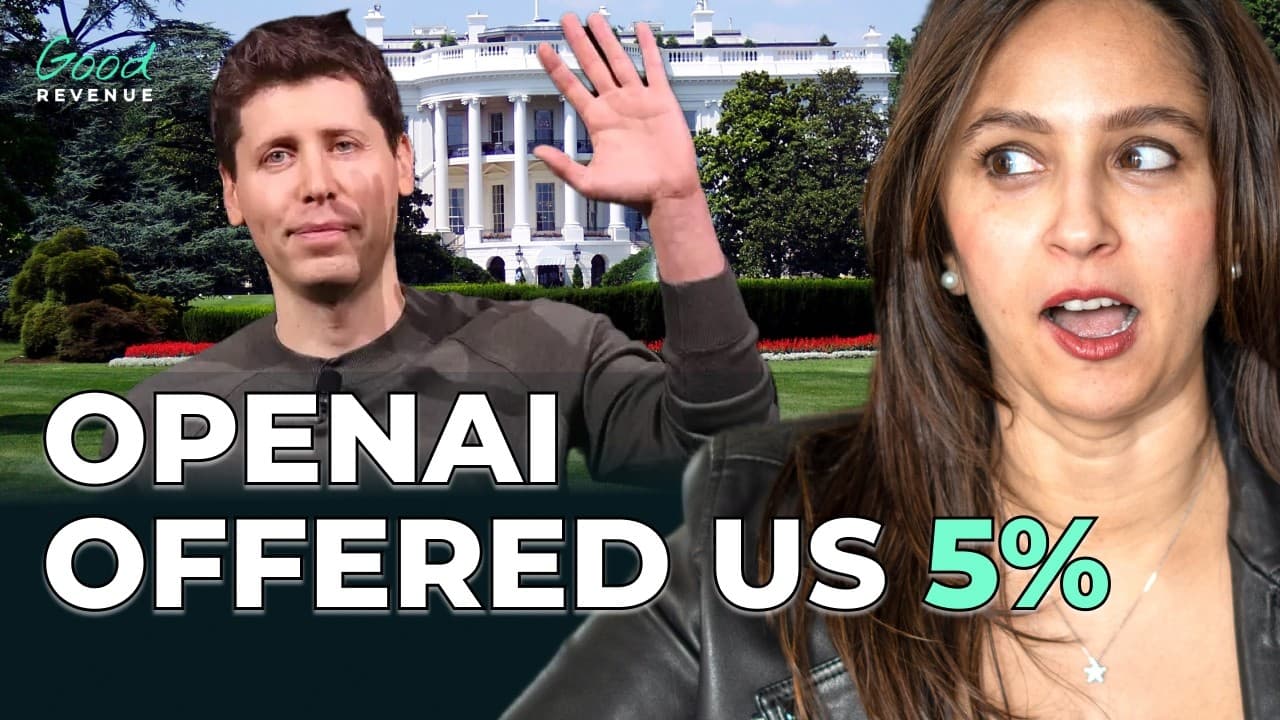
Altman is heading to Washington with a reported offer to give the US government 5% of OpenAI. The parallel being drawn is to Intel, where a government equity stake turned the commerce secretary into an active promoter of the company's interests. A sovereign wealth fund seeded with AI equity has support from unexpected corners of the political spectrum. If it materializes, it solves several problems for OpenAI simultaneously: it secures government backing, it creates a political constituency for OpenAI's survival, and it gives the administration a reason to restrict competitors.
OpenAI's financials make the urgency clear. The company is expected to remain deeply unprofitable for years, and a valuation above $1 trillion at IPO looks increasingly out of reach. Kimi K3 arriving free, functional, and widely available is not just a competitive nuisance. It is an existential pricing threat.
Who Pays the Bill
While the strategic maneuvering continues at the top, the cost is landing somewhere specific. Tech sector job cuts in the first half of 2026 totaled 139,000, an 83% increase over the same period in 2025. Hiring plans, according to Challenger, Gray and Christmas data, have collapsed relative to five years ago. The AI buildout has been sold as a transformation story. For workers, it has so far been a subtraction story.
No major company has yet reported meaningful P&L gains attributable to AI investment. The hundreds of billions committed to data centers, chips, and model development remain largely unrecouped. The business case is still being written.
What Comes Next
China's reported discussions about restricting its own training data exports and limiting foreign access to its model weights tell you something important about long-term intent. Open global distribution today, controlled domestic assets tomorrow. The razors are free right now. The blades will come later.
For the US government, the pressure is to act decisively in a situation where every option has a significant cost. Banning Chinese models alienates NVIDIA and restricts tools that US companies are already using for cybersecurity. Allowing them freely undermines the pricing power that US frontier labs need to justify their investment and reach profitability. Splitting the difference, as policy has largely done so far, is not satisfying anyone.
Kimi K3 is a product launch. It is also a stress test of whether the American AI industry can hold together when a well-resourced adversary decides to give its best work away.
Sources & Further Reading
Kimi K3: China's Open-Weight AI Offensive
- Kimi K3 License — What the Fine Print Actually Says
- White House Science Advisor Claims Kimi K3 Was Built on Stolen Anthropic IP
- Treasury Secretary Calls Chinese Open-Weight AI an Unacceptable IP Theft Risk
- The White House's Unsettled Strategy on Chinese AI Models
- Open Source AI Is Silicon Valley's New Battleground with China
- China Weighs Restricting AI Model Weights That US Companies Rely On
NVIDIA, Open Weights, and the AI Security Debate
- NVIDIA's Letter to the White House on Open-Weight AI and American Leadership
- Inside the Open Secure AI Alliance NVIDIA Just Launched
- Hugging Face Security Breach: An AI Agent Attacked Without Human Direction
- Anthropic's Official Position on Open-Weight AI Models
- NVIDIA CEO Jensen Huang Makes the Case for Open AI Models
- Why NVIDIA Is in Talks to Guarantee $250 Billion for OpenAI's Data Center
- NVIDIA Bets $5 Billion on Ilya Sutskever's New AI Lab
- Top US AI Executives Sound Alarm on Chinese Open-Weight Models
Sam Altman, OpenAI, and the IPO Endgame
Tech Job Cuts, Hidden AI Debt, and the Missing ROI