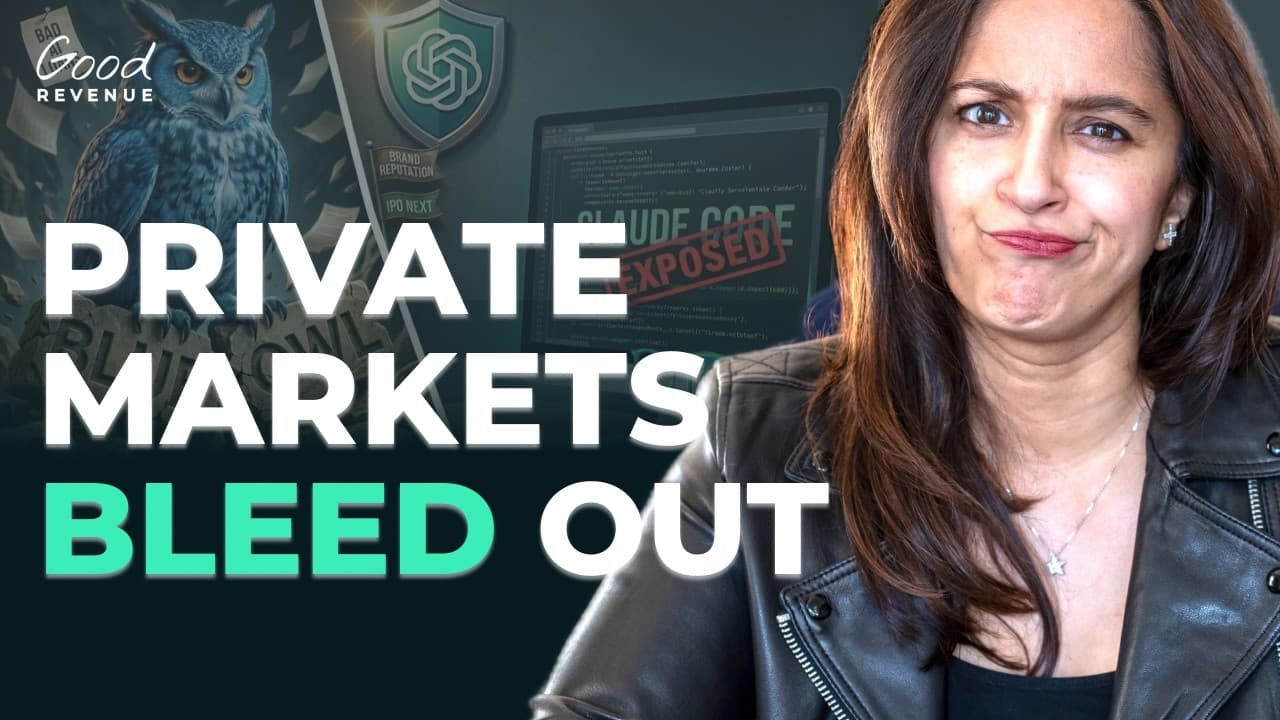
OpenAI Sidelined Its CFO Before Its Own IPO
A company heading to public markets without its top financial officer in the room is almost unheard of. The reason why makes the AI IPO race far more complicated.
The CFO Who Knew Too Much
There is a financial red flag so obvious it almost does not need explaining: you do not go public without your CFO. And yet, according to a report from The Information, that is precisely the situation OpenAI appears to be navigating. The company's CFO was effectively sidelined by CEO Sam Altman back in August 2025, demoted from reporting directly to the CEO to reporting instead to OpenAI's applications chief. The reason, as Neeta Bidwai puts it bluntly, is that the CFO was doing her job too well, raising concerns that OpenAI's business is not yet strong enough to support a successful IPO.
That is a remarkable thing to happen at any company. At one that has spent years positioning itself as the most consequential technology business on earth, it is something else entirely.
Anthropic Pulls Further Ahead
The contrast with Anthropic could not be starker. While OpenAI reshuffles its financial leadership and defers the hard questions about unit economics, Anthropic is quoting its own CFO prominently in public announcements and posting numbers that are difficult to argue with.
The company's revenue run rate has surpassed $30 billion as of early April 2026, up from $9 billion at the close of 2025. That is not a gradual climb. The number of enterprise customers spending more than a million dollars annually has doubled from 500 to 1,000 in under two months. And Anthropic has just announced an expanded TPU capacity deal with Google and Broadcom, with new infrastructure expected online by 2027, a clear signal the company is building for sustained scale rather than a sprint to a listing.
The IPO race between the two firms has been shifting week by week, but as of mid-April, Anthropic looks like it is in what Neeta calls "the catbird seat."
A Model Too Dangerous to Release Widely
Separate from the IPO storyline, Anthropic dropped a product announcement that deserves its own attention. Claude Mythos, its latest frontier model, is not being released to the general public. The reason is not that it is unfinished. It is that it is reportedly too capable.
Mythos has already identified thousands of high-severity vulnerabilities across every major operating system and web browser. Specific claims include a 27-year-old flaw in OpenBSD, one of the most security-hardened operating systems in existence, and a 16-year-old bug in FFmpeg. These claims have not yet been independently verified, but the roster of launch partners for Project Glasswing, the controlled rollout initiative, includes AWS, Apple, Google, Microsoft, Nvidia, Cisco, CrowdStrike, and JP Morgan Chase, among others. That is not the kind of list you assemble for a marketing exercise.
Mythos is priced accordingly. At $25 per million input tokens and $125 per million output tokens, it costs five times Anthropic's own Claude Opus 4.6. The message is clear: this is a premium defensive tool for serious buyers, not a consumer product.
The timing adds an uncomfortable layer. Claude Code's source code was inadvertently leaked by an engineer roughly two weeks before this announcement. The idea that a model capable of finding unknown vulnerabilities in every major OS is now itself a target for bad actors is not a hypothetical risk.
The Pentagon Complication
Anthropic is also fighting on a legal front. A federal appeals court in Washington DC ruled against the company this week in its ongoing dispute with the Department of Defense. The DOD had labeled Anthropic, an American company, as a supply chain risk after a contract dispute over whether Claude could be used for domestic mass surveillance and autonomous weapons systems, potentially including nuclear weapons. Anthropic refused those use cases. The Pentagon disagreed with the limits.
A separate court in San Francisco issued a temporary block of the ban, creating a split that Neeta suggests is likely headed toward the Supreme Court unless the two sides negotiate directly. And there is a plausible path to negotiation: Anthropic recently briefed the DOD on Mythos Preview. A model that can find vulnerabilities in every major piece of critical infrastructure software is exactly the kind of asset that makes a national security agency reconsider its posture toward a vendor.
What It Means Going Forward
The real story across all four of these developments is about credibility and governance at the exact moment it matters most. Anthropic is showing up with audited-looking numbers, a visible CFO, expanding infrastructure commitments, and a product pipeline that is generating genuine anxiety about its own power. OpenAI, meanwhile, is managing a leadership structure that raises questions about whether the people responsible for honest financial assessment are in the room when it counts.
Public markets are ruthless about this kind of thing. Investors do not just buy revenue; they buy the institutional confidence that the numbers mean what they say. Right now, one of these companies looks like it is building that confidence. The other looks like it is hoping no one asks.
Sources & Further Reading
- Anthropic’s Glasswing & Mythos AI: Inside the Next-Gen Cyber Defense Revolution
- Claude Mythos AI Battles Hackers — Anthropic’s Secret Weapon Against Cyberattacks
- Anthropic Briefs Pentagon on Mythos: AI Cybersecurity Power Preview
- Five Reasons Anthropic’s Cybersecurity Breakthrough Stayed Invite-Only
- Anthropic Glasswing Teaser on Instagram — Mythos Preview Shots
- Mythos AI Labs Behind the Scenes — Glasswing Project Visuals
- OpenAI Leadership Clash: CFO Sidelined Before IPO Over Ethics Dispute
- Court Rejects Anthropic's Attempt to Halt Pentagon AI Collaboration
- Anthropic Pentagon AI Case — Federal Judge Rules on Claude Mythos Deployment
- Official U.S. Court Filing: Anthropic vs Pentagon Cybersecurity Ruling PDF
- OpenAI Faces Health Fallout — New CMO Search After TBPN Deal & Employee Burnout