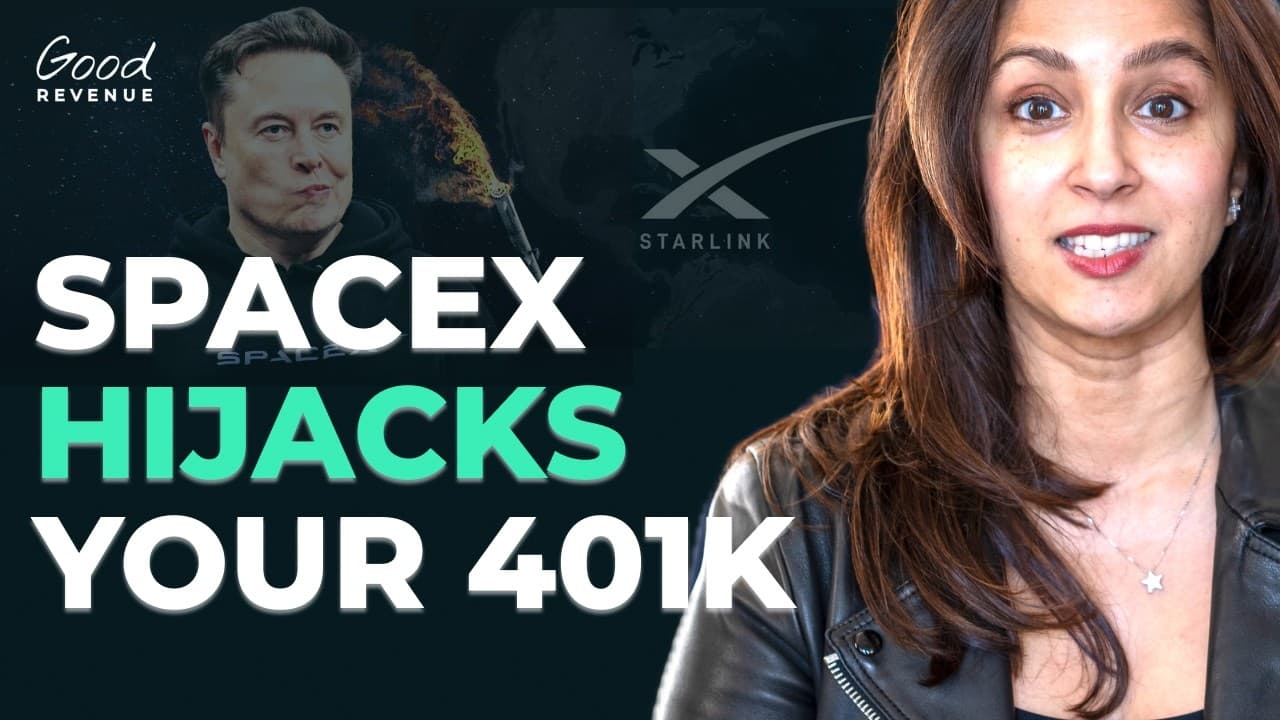
SpaceX Is Coming to Your Index Fund Whether You Like It or Not
Major indices have quietly rewritten their own rulebooks to fast-track SpaceX into passive portfolios. The question is who that actually benefits.
The IPO You Did Not Vote For
Here is something worth sitting with before SpaceX hits public markets on June 12: you may already be destined to own a piece of it. Not because you chose to, but because the three major indices quietly rewrote their inclusion rules to make sure of it.
Nasdaq slashed its minimum listing period before a stock can enter the Nasdaq 100 from 90 days to 15. FTSE Russell went further, cutting its window to just five days. The S&P 500 loosened its GAAP profitability and liquidity requirements. Each change, taken alone, might look like a routine administrative update. Together, they form a very clear runway for SpaceX and the mega-cap AI companies lining up behind it.
This episode of Good Revenue lays out why that matters, and why the story is more complicated than either SpaceX bulls or bears are letting on.
A Valuation With a Very Wide Spread
Start with the numbers, because they tell you something important about the temperature in the room. SpaceX is targeting a valuation of around $1.75 to $1.8 trillion, with an IPO raise of approximately $75 billion. That would be the largest public offering in history. Morningstar has responded by cutting its estimate to $750-780 billion, roughly half the asking price, based on prior private market valuations adjusted for the $250 billion acquisition of xAI last year.
The price-to-sales ratio sits at 107. Revenue is $18.67 billion, the majority of which flows from Starlink. The xAI business is burning $4.9 billion. The rocket business is roughly break-even. The S-1 claims a total addressable market of $28.5 trillion, a number that invites at least a raised eyebrow.
Morningstar's advice to investors is to wait. The firm expects the stock to pop at open and then decline materially once earlier private-round shares unlock and flood the market.
Why 30% Retail Allocation Is a Signal, Not a Gift
SpaceX is allocating up to 30% of shares to retail investors. That is a significant departure from standard IPO practice, where institutional investors dominate the book. The generous retail slice likely reflects two realities: Elon Musk has a devoted retail following willing to invest on enthusiasm alone, and serious institutional money appears cautious given the valuation gap and the structural risks in the S-1.
Scott Galloway, quoted in this episode, puts it bluntly. Private investors hold the best returns close until the valuation starts feeling stretched, then bring in public markets as the final buyer. The companies that once would have gone public at a $30-50 billion valuation now arrive at the door asking for nearly $2 trillion. That is not a coincidence. It is a strategy.
Governance That Defies Convention
The S-1 is unusual reading even by the standards of founder-led tech companies. Musk controls approximately 85% of voting shares. There is no independent board mandate. There is no succession plan. Control passes to his estate upon his death, meaning the governance structure is designed to outlast the founder himself.
For investors who have lived through what happens when concentrated power meets a public company without checks, this is not an abstract concern.
The Quiet Period That Was Not Quiet
One of the stranger footnotes involves a tweet. During what should have been a strict SEC-mandated quiet period, Musk publicly disclosed a compute deal with Anthropic worth $1.25 billion per month, totaling around $15 billion. That is real money for a company at this revenue scale.
The catch: it is a 180-day lease, terminable by either party with 90 days notice. It is not durable contracted revenue. It is a handshake dressed up as a headline, and it was shared outside the S-1 entirely.
What Comes Next
SpaceX is not going to the public markets because it needs retail capital to build rockets. It is going because private investors have decided the valuation has reached a point where public buyers are the logical next stop. Anthropic is close behind. OpenAI is likely drafting its own S-1 right now.
The index rule changes mean passive investors, the ones who simply buy the market and expect diversified, long-term exposure to the economy, will hold these companies whether or not they have studied the S-1. The stability and predictability that index investing is supposed to deliver gets harder to promise when the rulebook keeps changing to accommodate the newest and largest arrival.
The summer of 2026 will tell us a great deal about how much weight public markets can bear, and how much of that weight ends up on shoulders that never asked to carry it.
Sources & Further Reading
S 1 Filing Financials and Key Takeaways
SpaceX IPO Valuation and Pricing
IPO Mechanics Fees and Market Structure
Strategy Competition and Market Position